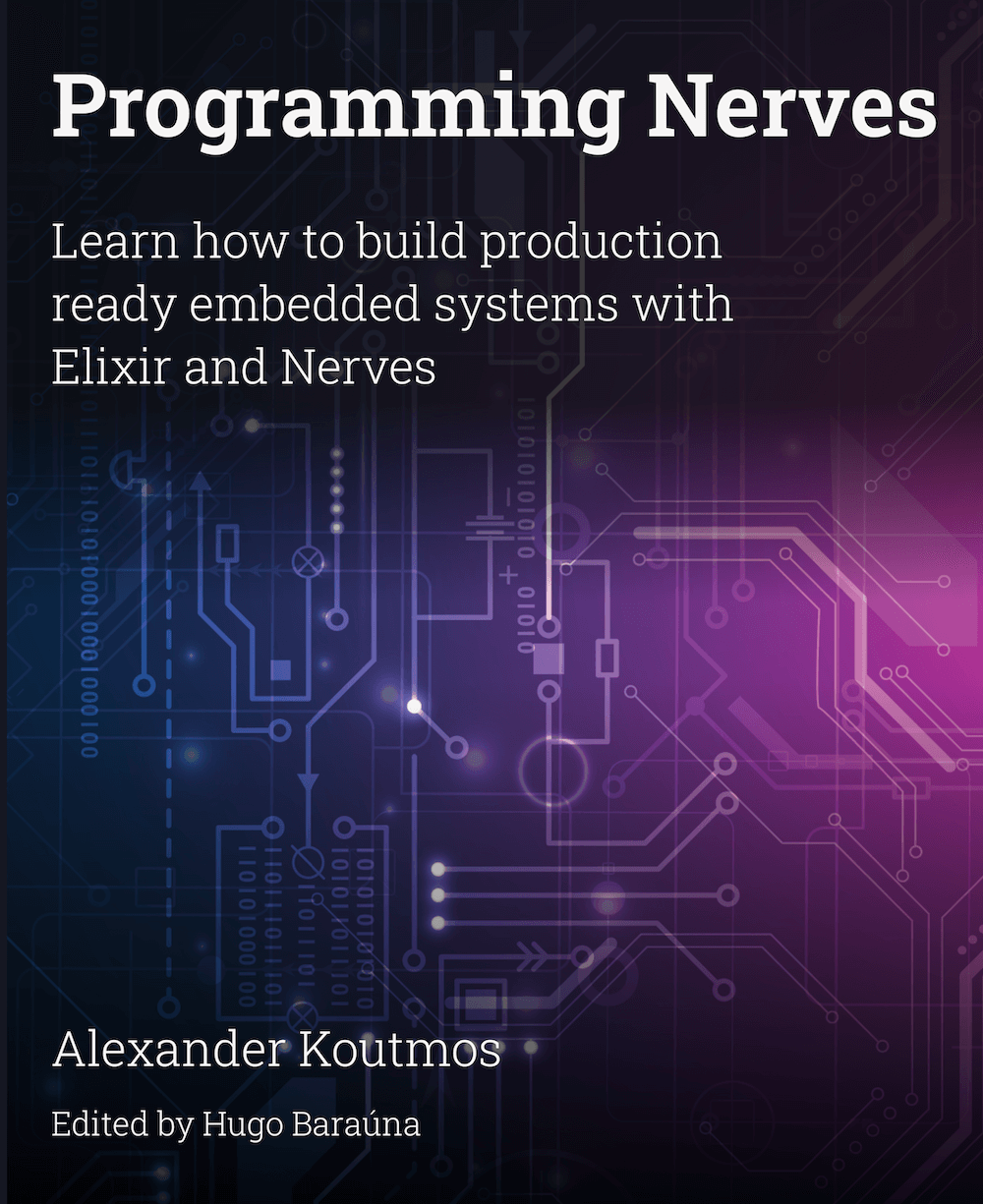
Discover how you can build embedded systems with Elixir and Nerves! Go from blinking LEDs to production Liveview powered kiosks, without the complexity of traditional embedded development.
Hardware development has a reputation for being mysterious and difficult. Slow burn cycles, cryptic C code, and the fear of bricking expensive devices.
But here's the truth: building embedded systems doesn't have to be like that anymore! Especially when you are using Elixir and Nerves.
You already know how to build web apps with Elixir. Now you'll learn how to apply those same skills to physical devices. Write Elixir code on your laptop, deploy it to a Raspberry Pi, and watch your embedded device come to life.
The goal of this book is to take you from hardware fundamentals to production-ready systems. You'll start off by rapidly prototyping Nerves applications within Livebook. Then, you'll build and deploy your own custom Nerves firmware that can read sensor data, control displays, and interact with the physical world.
Throughout this book you will learn how to:
Control hardware through GPIO pins using Nerves and its supporting libraries
Rapidly prototype hardware projects using Livebook
Use electrical components like LEDs, resistors, piezo speakers, potentiometers and analog-to-digital converters
Build real-world projects like a Morse code translator, a reaction time game and even an Etch A Sketch
Understand a hardware datasheet and control custom components
Communicate with external hardware using the SPI and I2C protocols
Deploy production firmware with OTP supervision and fault tolerance
By the end of the book, you'll have the skills to build your own IoT devices, smart home controllers, and embedded systems. You'll understand how digital devices really work under the hood, and you'll have expanded your skills into a whole new domain - all from the comfort of Elixir!
Learn embedded systems development with Elixir and Nerves through hands-on projects.
Programming Nerves takes you from zero to building production-ready embedded systems. Start with rapid prototyping using Livebook, then progress to custom firmware and real-world applications.
Part 1: Rapid Prototyping Nerves Using Livebook
Getting Started With Livebook27
Build a Morse Code Translator57
Build a Traffic Light Simulator77
Build a Reaction Time Game96
Building the Etch A Sketch CircuitComing soon
Programming the Etch A SketchComing soon
Part 2: Building Custom Nerves Firmwares
Build a Custom Nerves FirmwareComing soon
Optimizing Your WorkflowComing soon
Interfacing With I²C HardwareComing soon
Creating a Nerves KioskComing soon
Get Free Sample Chapters
Not sure yet? Grab free sample chapters to get started.
03Pricing
Get Programming Nerves
The first 4 chapters of Programming Nerves are complete and ready for you to embark on your Nerves journey. You'll learn how you can use the Nerves + Livebook firmware in order to experiment with hardware without having to burn custom firmware images every time you want to make a change. You'll learn how to blink your first LED and how to make a button controlled traffic light. New chapters ship as soon they are finished.
Buy now for early access and get 38% off the final price!
38% off!
$49
79
Beta version
Get early access while the book is under active development
5 accompanying Livebook notebooks already available
Walk-through videos for assembling circuits (coming soon)
Free updates as new chapters ship
Final version included at release
04Author
Alex Koutmos
Alexander Koutmos has been writing software professionally for over a decade and started working primarily with Elixir back in 2016. He currently maintains a few Elixir libraries on Hex, is a host on the BEAM Radio podcast, and wrote books Build a Weather Station with Elixir and Nerves and Elixir Patterns.
Hugo Barauna is a developer advocate at Dashbit (Livebook / Tidewave), and the maintainer of Elixir Radar. Before that, he was one of the co-founders of Plataformatec, the company where the Elixir language was created.